Select Page

INSULATION SUPPLIES IN TORONTO And The GTA

We offer only the best-quality insulation supplies

  • We deliver premium building supplies for all your needs
  • Over 50 years in the construction business
  • ⁠Serving Toronto, Mississauga, and other areas of the GTA

visit our shop

Weston Yard (Head Office)
469 Garyray Drive, Toronto, ON, M9L 1P9

Mississauga Yard
2235 Royal Windsor Drive, Mississauga, ON, L5J 1K5

We Deliver. Contact Us 1-877-741-0941
bernardi at work
50+ years of experience
who we are

Wide Range of Insulation Supplies in Toronto Under One Roof

Whether you are insulating a new home, upgrading an attic, or handling a commercial roof, our two locations keep the insulation products you need in stock: batts, rigid foam, sound insulation, house wrap, and accessories such as vapour barrier, tape, and fasteners. We carry trusted brands including Rockwool, CertainTeed, and Soprema, and we can custom-order materials that aren’t on the shelf.

counter staff have decades of experience in the insulation industry, so if you’re not sure which product suits your project, bring your measurements and we’ll walk you through the options. We deliver across Toronto, Mississauga, and the rest of the GTA — and for many customers, orders placed by phone are ready the same day for pickup

Insulation Building Supplies bg

Guide to Buying Insulation Supplies in Toronto

Buying the right insulation comes down to three questions: where it’s going, what R-value you need, and your budget.

Where it’s going. Open attics take blown-in or batts; wall cavities take batts or spray foam insulation; basements and foundations call for rigid foam or Rockwool, which handle moisture better than fiberglass; rim joists and irregular gaps are the strongest case for spray foam.

What R-value you need. In Toronto’s climate, most attics should be insulated to R-50–R-60, above-grade walls to roughly R-22 or better, and basement walls to about R-20. If your house was built before the 1980s and never upgraded, you are almost certainly below these levels.

Your budget. Fiberglass insulation is the most affordable per square foot; Rockwool costs more but adds fire and sound performance; foam insulation — rigid board or two-component spray foam — costs the most but delivers the highest R-value per inch and air-seals as it insulates. Bring your square footage and cavity depth to either yard and we’ll price the options side by side.

How insulation works

Insulation works by trapping millions of tiny air pockets that slow the movement of heat through walls, roofs, and floors. Heat always flows from warm to cold — out of your house in winter, into it in summer — and insulating materials like fiberglass, stone wool, and polyurethane foam resist that flow. The less heat that escapes, the less energy your furnace and air conditioner burn to hold a steady temperature, and the lower your energy costs. Proper insulation also keeps interior surfaces warmer in winter, which reduces condensation, drafts, and cold floors.

R-Values

An R-value measures how well an insulating material resists heat flow: the higher the R-value, the better the overall performance. R-value adds up with thickness — two inches of R-6-per-inch polyiso gives R-12. When comparing insulation products, compare the installed R-value for your cavity, not just the number on the bag, because compressed or gapped insulation loses performance.

How much insulation is required?

For the Toronto area, aim for R-50 to R-60 in the attic, R-22+ in above-grade walls, R-20 for basement walls, and R-31 for exposed floors. Natural Resources Canada reports that space heating alone accounts for about 62% of the energy used in Canadian homes — which is why the attic, the biggest escape route for heated air, is the most cost-efficient place to add insulation first.

Other Areas That Require Insulation

Walls and attics get the attention, but heat and noise leak from smaller spots too: heating and cooling ducts running through unconditioned space should be wrapped; hot-water plumbing pipes benefit from polyethylene pipe insulation; rim joists, garage ceilings under bedrooms, floors over crawl spaces, and attic hatches all deserve coverage. Insulating ducts in particular can noticeably improve the efficiency of a forced-air system, since leaky, uninsulated ducts dump heated air into spaces you’re not living in.

PROFESSIONAL ASSISTANCE

More insulation tips

Ensure your house is perfectly ventilated. Enough ventilation can prevent loss of too much heat and prevents condensation. Fix all leaks to prevent air from entering or exiting in areas around the doors and windows. Remember, leaks should be fixed before the installation of insulation, as it’s challenging to fix them once the insulation is in place.

Lastly, wear protective gear when handling insulation to avoid breathing in harmful substances or irritating your skin. Afterward, vacuum your clothes to ensure you don’t come into contact with materials that could irritate your skin.


Different Brands and Types of Insulation

Fiberglass Batts
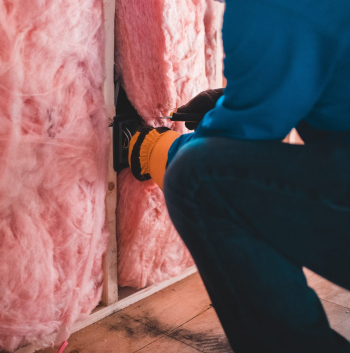
Fiberglass batts are the most affordable way to insulate standard wood-framed walls, ceilings, and floors. They are fire resistant, don’t absorb moisture, and are manufactured largely from recycled glass. Batts come in widths sized for standard stud and joist cavities, which keeps installation fast for both pros and DIY homeowners.
Polyiso
Polyisocyanurate (polyiso) is a rigid foam insulation with the highest R-value per inch of thickness we stock — roughly R-6 per inch. It is installed in over 70 percent of commercial roof construction and works equally well as continuous exterior insulation over walls, cutting thermal bridging through studs.
Tyvek® House Wrap
Tyvek® ThermaWrap® creates a tight building envelope: it blocks wind and water from the outside while letting moisture vapour escape from inside the wall. The result is a drier wall assembly, lower load on your home’s heating and cooling system, and protection against rot and mould.
Roxul (Rockwool) Insulation
This semi-rigid stone-wool insulation is designed for wood and steel stud applications in residential and commercial construction. Rockwool is naturally fire resistant to over 1,000°C, repels water, and holds its shape in the cavity without sagging — a durable choice for basements and exterior walls.
Sound Attenuation Blankets (SABs)
Sound attenuation blankets are lightweight, unfaced fiberglass batts designed for noise control in interior partitions. They’re a low-cost way to quiet bedrooms, home offices, and mechanical rooms, and they’re widely used in commercial demising walls.
Polyethylene
Polyethylene insulation is a durable, lightweight closed-cell foam used for pipe insulation, sill gaskets, and vapour barrier applications. Because the cells are closed, it won’t take on water — which makes it a reliable choice around plumbing and below grade.
Safe ’n’ sound
Rockwool Safe’n’Sound® is a stone-wool batt made specifically for interior walls and floors where soundproofing and fire protection matter more than R-value. Many homeowners use it around bathrooms, laundry rooms, and media rooms.
Reflective Insulation
Reflective insulation uses a foil surface to reflect radiant heat instead of absorbing it. It shines in attics, garages, and around ducts, where it helps keep summer heat out and reduces cooling costs.
Rigid Foamboard
From white EPS foamboard — an easy, economical DIY option — to extruded Styrofoam™ panels for foundations and below-grade walls, rigid foam adds continuous R-value in limited thickness. It’s the standard choice for basement walls, slab edges, and cathedral ceilings.
fiberglass batt insulation

More Insulation Tips

Proper insulation installation is about more than simply adding material. Following a few important practices can improve energy efficiency, control moisture, and help your insulation perform effectively for years.

  • Air-seal before insulating: Caulk gaps, foam around window and door frames, and weatherstrip the attic hatch to reduce air leakage.
  • Never block soffit vents: Keep attic ventilation clear to maintain airflow and help control moisture.
  • Wear proper protection: Use gloves, safety glasses, and a dust mask when handling fiberglass insulation.
  • Clean up safely: Use a shop vacuum rather than sweeping insulation dust and fibres into the air.
  • Don’t compress insulation batts: Compressing batts can reduce their effectiveness and R-value.
  • Install the vapour barrier correctly: In cold-climate walls, the vapour barrier is generally installed on the warm side of the insulation.
Insulation Toronto

The Benefits of Proper Insulation

A properly insulated house costs less to run, feels better to live in, and is worth more when you sell. Cutting heat loss lowers energy costs every month, in both heating season and cooling season. Consistent temperatures room to room end the cold-bedroom problem, and dense products like Rockwool add real noise reduction between floors and from the street.

Insulation is also one of the most eco-friendly upgrades a property can get — less energy burned means a smaller carbon footprint — and modern fire-resistant materials add a genuine layer of safety and security to the building envelope. Additionally, upgraded insulation protects the structure itself by keeping wall assemblies drier.

While you want the best insulation available, it’s also important to choose a solution that is cost-effective for your project. Turn to a reliable, knowledgeable supplier like Bernardi Building Supply, where the experienced team can help you choose the right insulation for optimal performance and long-term savings.

Visit Bernardi Building Supply’s Weston Yard (Head Office) at 469 Garyray Drive, Toronto, ON M9L 1P9, or call 416-741-0941 for expert assistance with your insulation needs.

Frequently Asked Questions

What R-value do I need for an attic in Toronto?

Most Toronto attics should be insulated to R-50–R-60. Homes built before the 1980s often have R-20 or less, so topping up is usually the single best energy upgrade available. Check your current depth: about 8 inches of old fiberglass is only around R-25.

What’s the difference between spray foam insulation and rigid foam board?

Spray foam insulation is applied wet and expands to air-seal irregular gaps, rim joists, and tricky cavities. Rigid foam board is a fabricated panel — EPS, XPS, or polyiso — best for flat surfaces like basement walls and roofs. Foam board is DIY-friendly; two-component spray foam is usually installed by a pro.

Which insulation is best for soundproofing interior walls?

Rockwool Safe’n’Sound® and sound attenuation blankets are the two products we recommend most for interior partitions. Both are dense enough to absorb airborne noise and are sized for standard stud cavities.

Do you deliver insulation supplies across the GTA?

Yes. We deliver from our Toronto and Mississauga yards across the GTA, including Brampton, Burlington, and Oakville. Call 416-741-0941 with your order and postal code and we’ll confirm the delivery window.

Can homeowners buy here, or is it contractors only?

Both. Contractors make up much of our business, but homeowners are welcome at either location, whether you need a full attic’s worth of batts or a single sheet of foamboard. Volume pricing is available on larger orders.

Does insulation help in summer too?

Yes. The same materials that hold heat in during winter keep it out in summer, easing the load on your air conditioning. Reflective insulation and good attic ventilation are especially effective against summer heat gain.

our recent articles

Learning Center

  • How Much will you Pay for Blown-in Insulation?
    anemptytextlline
    How Much will you Pay for Blown-in Insulation? If you’re on a mission to increase the comfort of your home, blown-in insulation could be a worthwhile investment. Like all other...
    Learn More
  • 5 Things You Can’t Insulate with Foam
    anemptytextlline
    5 Things You Can’t Insulate with Foam Did you know that spray foam insulation has been in use since 1986? Many homeowners with new construction projects are going for this product due...
    Learn More
  • Can Spray Foam Stop Foundation and Basement Leaks?
    anemptytextlline
    Can Spray Foam Stop Foundation and Basement Leaks? Did you know that rainfall totals are increasing across the U.S? One thing that comes with this rise in precipitation is flooding in the...
    Learn More
  • What is Foam Board Insulation and Why Do You Need It?
    What is Foam Board Insulation and Why Do You Need It?
    anemptytextlline
    What is Foam Board Insulation and Why Do You Need It? When and How You Might Need to Use Foam Board Insulation Foam board insulation consists of insulation panels made from...
    Learn More
  • Insulation Building Supplies bg
    Insulation: Complete Guide
    anemptytextlline
    Insulation: Complete Guide Introduction Home and business owners in Toronto and the rest of Ontario should insulate their homes for indoor comfort. Toronto, ON has a humid continental climate characterized by...
    Learn More
  • Insulation Building Supplies bg
    How to Insulate an Attic?
    anemptytextlline
    How to Insulate an Attic Insulating your attic is one of the best ways of lowering energy bills and making your home greener. The best thing is the attic is...
    Learn More
  • Insulation Building Supplies bg
    Everything about Insulating a Basement
    anemptytextlline
    Everything about Insulating a Basement Introduction Basement insulation involves the application of an insulating layer on a basement’s exterior wall, interior wall, or both. Floors, ceilings, and joist header spaces...
    Learn More
  • How to Insulate a Flat Roof in Various Ways
    How to Insulate a Flat Roof in Various Ways
    anemptytextlline
    How to Insulate a Flat Roof in Various Ways Can you put insulation on a flat roof? A flat roof, whether as part of an extension or covering the whole...
    Learn More
  • How to Get Rid of Popcorn Ceiling in no Time
    How to Get Rid of Popcorn Ceiling in no Time
    anemptytextlline
    How to Get Rid of Popcorn Ceiling in no Time Popcorn ceilings were trendy in the 1960s and 70s. This type of ceiling, which also goes by the name stipple...
    Learn More
Contact Us For A

free consultation

1-877-741-0941

visit our shop

Weston Yard (Head Office) 469 Garyray Drive, Toronto, ON, M9L 1P9

get your free quote